 UPM AI HUB
» CLUSTER AGRICULTURE & BIODIVERSITY
DIGITAL TWIN INTERACTIVE AUGMENTED REALITY IN AQUAPONICS IOT SYSTEM
PROJECT SUMMARY
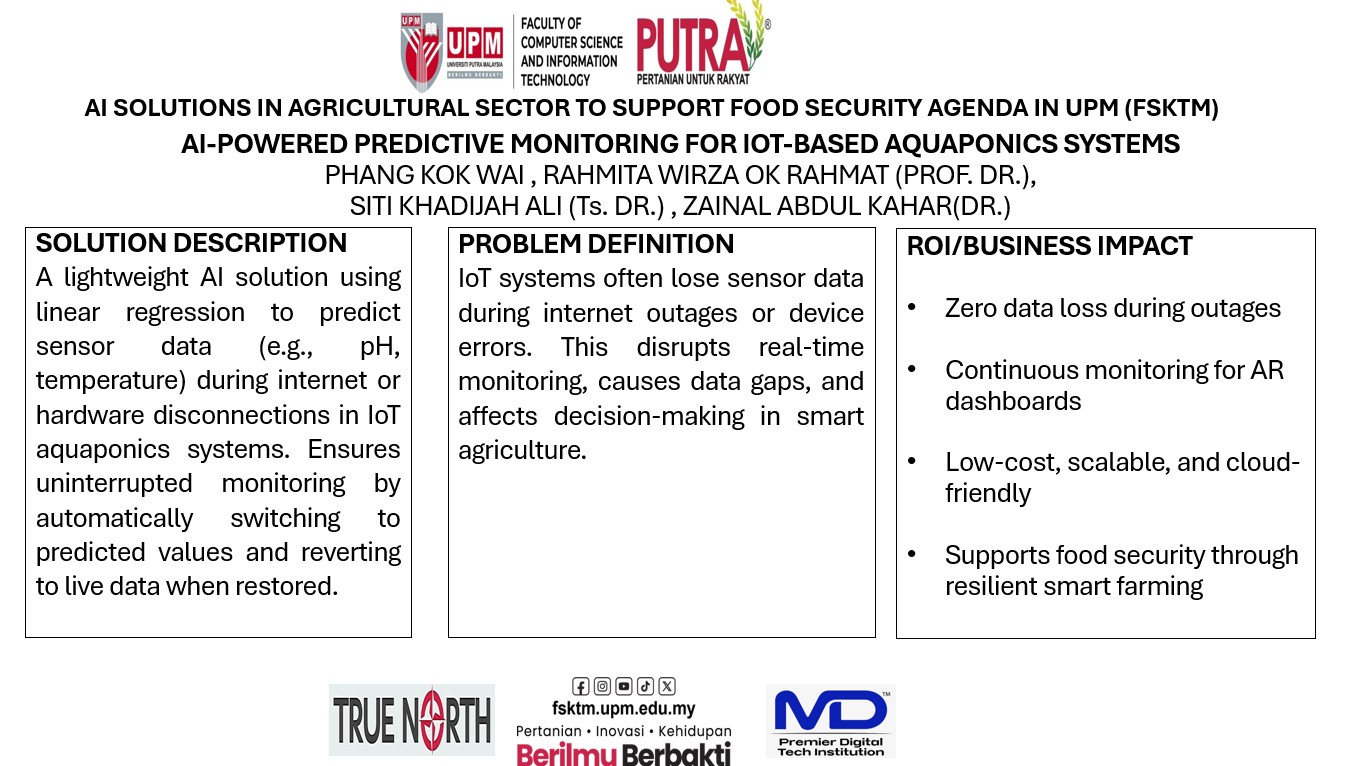
The project demonstrates a real time episode for aquaponics system management that includes Internet of Things (IoT) sensors, a Digital Twin (DT), and Augmented Reality (AR) to provide greater usability, responsiveness, and sustainability. The aquaponics system utilized WebSocket communication to deliver near real-time updates of the sensor data, local buffering to avoid data loss during internet outages, and used a simple linear regression algorithm to estimate the missing sensors for continuous real-time data. The AR interface provided a heads-up display of live operational data and alerts directly on the physical aquaponics setup to facilitate interaction, while the system's touch-analysis recognized mistouches and assisted in remedying the mistouch to allow the user to interact accurately. The framework is designed for a non-technical user group to enable effecient, accessible, and sustainable aquaponics systems to be operational.
IMPACT
With the objectives of merging hydroponics with aquaculture for sustainable food production, aquaponics systems still face some key dimensions of the sustainability vision on scalability and efficiency. The absence of real-time monitoring and intuitive interfaces, thus, makes the current systems difficult to maintain for the general public with non-technical knowledge. The affinity between the operational data is weakly vertical, and due to the poor user engagement, good decision-making is seldom achieved. These issues pose a challenge to timely decision-making, hence cutting productivity and sustainability in the long run. New innovative solutions are then needed to manage more easily with user engagement. This research is addressing the above-mentioned problems via the integration of the technologies called Digital Twin (DT) and Augmented Reality (AR). The DT replicates the customizable real-time aquaponics setup to monitor and for predictive analytics and simulation of various scenarios based on the Internet of Things (IoT) sensor data. The AR interface superimposes actionable insights, such as pH levels, nutrient status, equipment fault diagnostics, and so forth, onto the physical components, thereby allowing users to spatially interact with the data. This combination is vital in reducing the technical complexities for easy access while providing a platform that reduces manual interventions by 35% and improves the resolution time for anomalies by 28%. By blending predictive modelling with immersive interaction, the framework now moves in the direction of intelligent user-centric aquaponics systems for sustainable agriculture.
RESEARCHER
Dr. Siti Khadijah binti Ali (Ketua), Rahmita Wirza, OK Rahmat, Phang Kok Wai, Zainal Abdul Kahar
Universiti Putra Malaysia